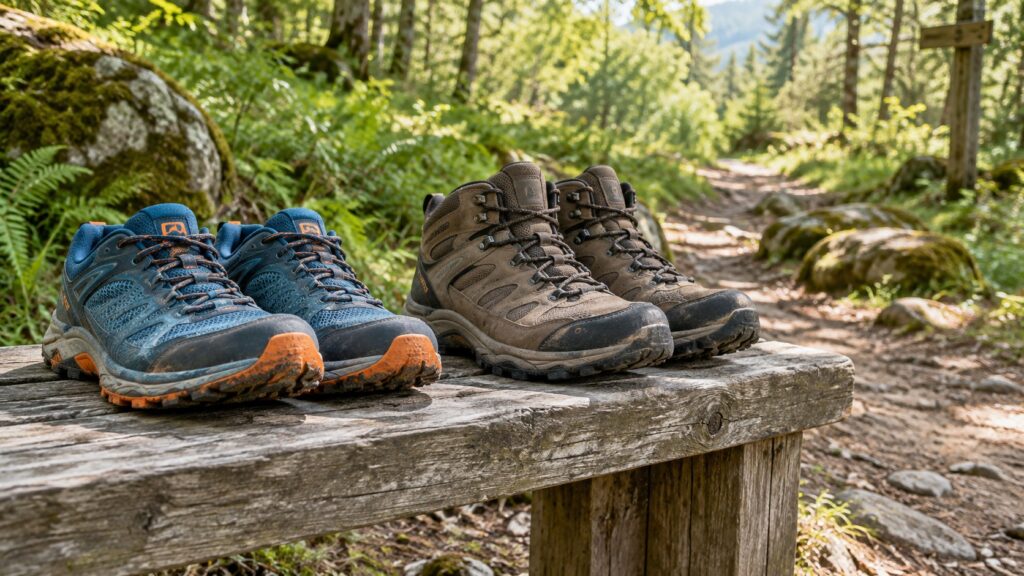
Choose footwear for the route and the load you carry, then make fit the deciding factor. Trail running shoes can be a comfortable option for many walks, while hiking shoes offer another balance of structure, protection and durability. Neither label tells you everything about a particular pair.
Researched September 2026. This is an editorial buying guide, not a hands-on footwear test or personalised medical advice. The cover is an AI-generated illustration of generic trail footwear.
Understand the three categories
| Category | Typical emphasis | Check carefully |
|---|---|---|
| Trail running shoe | Lower weight and flexibility for moving over trails | Protection, fit and outsole suitability for your route |
| Low hiking shoe | A walking-focused balance of structure and protection | Weight, flexibility and comfort over a full day |
| Hiking boot | A higher collar and a potentially more substantial build | Actual construction, not collar height alone |
There is considerable overlap. A rugged trail runner may feel more protective than a light hiking shoe, and a lightweight boot may be more flexible than its appearance suggests. Compare individual designs instead of ranking entire categories.
Start with your usual route
REI’s footwear guidance distinguishes lighter, more flexible trail-running designs from hiking shoes and highlights terrain as a central choice. For a familiar, maintained woodland path with a light day bag, a trail runner is worth trying. If your normal walk includes repeated contact with rocks or rough ground, compare how different shoes protect and secure the foot.
Do not buy for a once-in-a-lifetime expedition when most of your walking is local. Conversely, do not use a short pavement try-on as proof that a shoe suits a demanding mountain route. More technical terrain, winter conditions or equipment requirements call for route-specific advice and appropriate footwear.
What a hiking shoe can offer
A low hiking shoe is worth comparing when you want a walking design without a boot’s higher collar. Look at the toe protection, upper and sole construction. Try bending and walking in the shoe rather than assuming stiffness or softness is always desirable. The useful question is whether it feels comfortable and controlled on the kind of ground you expect.
If you carry a substantial pack, include that fact when seeking a fitting. Personal experience and the whole setup matter more than a rule that everybody needs either the lightest shoe or the tallest boot. A high collar is not a guarantee against ankle injuries.
Waterproofing is a trade-off
REI notes that waterproof footwear can help keep feet drier initially in wet conditions, while mesh options can drain and dry more quickly after water enters. Think about temperature, puddles, wet vegetation and the likelihood of water coming over the opening. Waterproofing should solve a problem you actually encounter.
Also inspect the tread. Different surfaces ask different things of a sole, and a waterproof upper says nothing about grip on a particular wet surface. Check the manufacturer’s intended use and avoid treating an aggressive-looking pattern as proof of universal traction.
Use a realistic fitting routine
- Wear the socks and any inserts you normally use.
- Try both feet and check for pressure across the forefoot.
- Check heel hold without overtightening the laces.
- If a shop has an incline, assess whether your toes contact the front on the way down.
- Confirm permitted indoor testing and return conditions before wearing the pair outside.
Our foot-measuring guide can help you start with measurements, but the final fit depends on the model’s shape.
The Choos recommendation
Try trail runners for lighter, familiar walks and compare hiking shoes when their structure and protection better match the route. Keep an open mind about both. A comfortable, suitable pair is a better purchase than winning an argument about footwear categories.